
This is a recording of a recent live teleclass I did with thousands of kids from all over the world. I’ve included it here so you can participate and learn, too!
We’re going to study electrons and static charge. Kids will build simple electrostatic motor to help them understand how like charges repel and opposites attract. After you’ve completed this teleclass, be sure to hop on over the teleclass in Robotics!
Electrons are strange and unusual little fellows. Strange things happen when too many or too few of the little fellows get together. Some things may be attracted to other things or some things may push other things away. Occasionally you may see a spark of light and sound. The light and sound may be quite small or may be as large as a bolt of lightning. When electrons gather, strange things happen. Those strange things are static electricity.
[am4show have=’p8;p9;p11;p38;p92;p76;p20;p47;p97;p58;’ guest_error=’Guest error message’ user_error=’User error message’ ]
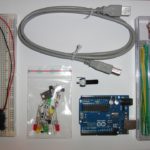
Materials:
- Balloon (7-9″, inflated with air, not helium)
- AA battery case
- 2 AA batteries for your battery case (cheap dollar-store “heavy duty” type are perfect. Don’t use alkaline batteries if you can help it, because kids are going to short circuit their circuits, and the cheaper kind are safer in case they do.)
- 1-2 LEDs
- Alligator wires
- 1.5-3V DC motor
- 3-6V buzzer
If you want to make the laser burglar alarm, then get these also:
- OPTIONAL: CdS Photoresistor for the laser burglar alarm
- OPTIONAL: 9V Battery for laser burglar alarm
- OPTIONAL: Laser pointer (the cheap kind from the dollar store work great) or strong flashlight for the laser burglar alarm
If you want to make the first robotics projects then also get these:
- OPTIONAL: block of foam (any kind will do that is at least 2″ on each side)
- OPTIONAL: 10 (or more) wood skewers at least 4″ long
- OPTIONAL: 1 wood clothespin
- OPTIONAL: Hot glue and glue sticks (with adult help)
If you want to make the second robotics project then also get these:
- OPTIONAL: Additional 3V DV motor (you need two for this project)
- OPTIONAL: 6 large popsicle sticks (tongue depressor size)
- OPTIONAL: Tack or other sharp object for poking holes
- OPTIONAL: Hot glue and glue sticks (with adult help)
Key Concepts
The proton has a positive charge, the neutron has no charge (neutron, neutral get it?) and the electron has a negative charge. These charges repel and attract one another kind of like magnets repel or attract. Like charges repel (push away) one another and unlike charges attract one another. Generally things are neutrally charged. They aren’t very positive or negative, rather have a balance of both.
Things get charged when electrons move. Electrons are negatively charged particles. So if an object has more electrons than it usually does, that object would have a negative charge. If an object has less electrons than protons (positive charges), it would have a positive charge. How do electrons move? It turns out that electrons can be kind of loosey goosey.
Depending on the type of atom they are a part of, they are quite willing to jump ship and go somewhere else. The way to get them to jump ship is to rub things together. Like in our experiment we’re about to do…
What’s Going On?
In static electricity, electrons are negatively charged and they can move from one object to another. This movement of electrons can create a positive charge (if something has too few electrons) or a negative charge (if something has too many electrons). It turns out that electrons will also move around inside an object without necessarily leaving the object. When this happens the object is said to have a temporary charge.
When you rub a balloon on your head, the balloon is now filled up with extra electrons, and now has a negative charge. Opposite charges attract right? So, is the entire yardstick now an opposite charge from the balloon? No. In fact, the yardstick is not charged at all. It is neutral. So why did the balloon attract it?
The balloon is negatively charged. It created a temporary positive charge when it got close to the yardstick. As the balloon gets closer to the yardstick, it repels the electrons in the yardstick. The negatively charged electrons in the yardstick are repelled from the negatively charged electrons in the balloon.
Since the electrons are repelled, what is left behind? Positive charges. The section of yardstick that has had its electrons repelled is now left positively charged. The negatively charged balloon will now be attracted to the positively charged yardstick. The yardstick is temporarily charged because once you move the balloon away, the electrons will go back to where they were and there will no longer be a charge on that part of the yardstick.
This is why plastic wrap, Styrofoam packing popcorn, and socks right out of the dryer stick to things. All those things have charges and can create temporary charges on things they get close to.
Questions to Ask
- Does the shape of the balloon matter? Does hair color matter?
- What happens if you rub the balloon on other things, like a wool sweater?
- If you position other people with charged balloons around the table, can you keep the yardstick going?
- Can we see electrons?
- How do you get rid of extra electrons?
- Rub a balloon on your head, and then lift it up about 5 inches. Why is the hair attracted to the balloon?
- Why does the hair continue to stand on end after the balloon is taken away?
- Why do you think the yardstick moved?
- What other things are attracted or repelled the same way by the balloon? (Hint: try a ping pong ball.)
[/am4show]

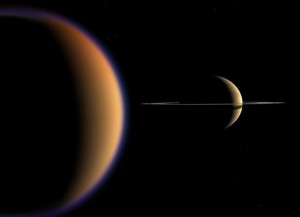 The solar system is the place that is affected by the gravity our sun. Our solar system includes rocky terrestrial planets (Mercury, Venus, Earth, and Mars), gas giants (Jupiter and Saturn), ice giants (Uranus and Neptune), and assorted chunks of ice and dust that make up various comets and asteroids. The eight planets follow a near-circular orbit around the sun, and many have moons.
Two planets (Ceres and Pluto) have been reclassified after astronomers found out more information about their neighbors. Ceres is now an asteroid in the Asteroid Belt between Mars and Jupiter. Beyond Neptune, the Kuiper Belt holds the chunks of ice and dust, like comets and asteroids as well as larger objects like dwarf planets Eris and Pluto.
Beyond the Kuiper belt is an area called the Oort Cloud, which holds an estimated 1 trillion comets. The Oort Cloud is so far away that it's only loosely held in orbit by our sun, and constantly being pulled gravitationally by passing stars and the Milky Way itself. The
 The nuclear reactions deep in the core transforms 600 million tons per second of hydrogen into helium. This gives off huge amounts of energy which gradually works its way from the 15 million-degree Celsius temperature core to the 15,000 degree Celsius surface.
Active galaxies have very unusual behavior. There are several different types of active galaxies, including radio galaxies (edge-on view of galaxies emitting jets), quasars (3/4 view of the galaxy emitting jets), blazars (aligned so we're looking straight down into the black hole jet), and others. Our own galaxy, the Milky Way, has a super-massive black hole at its center, which is currently quiet and dormant.
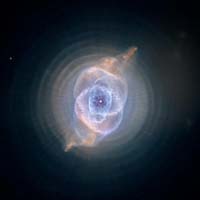
Dying stars blow off shells of heated gas that glow in beautiful patterns. William Hershel (1795) coined the term ‘planetary nebula' because the ones he looked at through 18th century telescopes looked like planets. They actually have nothing to do with planets – they are shells of dust feathering away.
When a star uses up its fuel, the way it dies depends on how massive it was to begin with. Smaller stars simply fizzle out into white dwarfs, while larger stars can go supernova. A recent supernova explosion was SN 1987. The light from Supernova 1987A reached the Earth on February 23, 1987 and was close enough to see with a naked eye from the Southern Hemisphere.



 Summer is the perfect season to bring in new learning activities into the lives of your homeschooled children. You are not as focused on classroom activities, formal lessons are on a break, and its time to have some fun. Make that fun instructive and you have a set of learning activities that you can do in the summer holidays.
 There are more children being homeschooled today than ever before. The statistical data seems to suggest that most parents tend to prefer homeschooling their children rather than sending them to a regular school to attend regular classes. What is the reason for this drastic shift in the way education is imparted?




















 Recording the progress of your homeschooled child is an important part that many first time homeschooling parents do not pay much attention to. However if at a later date your child wishes to study in a regular school or college a yearly record of the child’s learning activities will be needed for the teachers to assess the child’s level of preparedness. Here is how you can make a homeschool progress portfolio for the academic year for your child.




 If you are planning on considering home schooling for your child, it would be well worth answering these questions honestly. It will give you an idea about just how suited you are to become a homeschool teacher.

 If you are planning to homeschool your children here is a set of skills that you should develop. They will help ensure that things run smooth in your home school classes.

 To be able to develop a scientific understanding of common place events around us it is essential that children understand the basic concepts behind them. In order to do so they need to be taught a few fundamental basics across a multitude of scientific topics. Don’t worry about some topics or concepts being out of their grasp, once you begin teaching them, it will amaze you how quickly they pick up complex concepts. It all comes down to what you share with them and how you do it. Here are a few simple topics that you can begin with.

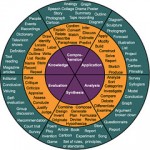

 The popularity of homeschooling has never been higher. More parents are choosing to home school their children than ever before and this has also led to certain styles and models or homeschooling. One term which recently came to my notice was “Eclectic Homeschooling”. Here is what this new term is all about.
 Just being a homeschooler does not mean that your system of studies is the same as any other homeschooling family’s. Besides the traditional homeschooling technique which is modeled on regular school there are a multiple number of choices in techniques and methods available to homeschooling parents today. Some of these are briefly discussed here.
 Homeschooling parents have a multitude of methods of teaching available to them today. Besides the Charlotte Mason Method, Montessori Method, and Unit Studies that were mentioned in the last blog post there are other techniques that are used by homeschooling families. Here we discuss a few more techniques that can be used by homeschooling parents.
 We have seen that a number of methods to teach homeschooling students exist. So what works best to teach science to homeschool students? There is no one size fits all solution to teaching science. The personality of your child will determine which method is likely to be more successful than the other. At the same time your guidance as a parent is important to introduce the child to the world of science in a systematic and easy to figure out manner. Here are a few tips and tricks that you can use while teaching science to your children.






 There is an abundance of homeschooling material available in the market and online today. Parents can pick up books, workbooks, and practice sheets from a variety of different vendors. In fact on some homeschooling forums you can even download material that other parents are sharing for free. The question that now arises is, where should you buy your homeschool materials from? The answer depends on what you are looking for in particular.




 Homeschooling your children can be a rather solitary activity for the most with you being the only adult involved in your children’s schooling. Sometimes it helps to know that you are not alone. That is why it is interesting to read about the experiences of other homeschooling mothers through their blogs. And once in a while you may hit a resource that they are sharing which you may have use for. Given here are three websites that may help to offer you a different view on homeschooling than your own.

 There are a lot of reasons people will give you for homeschooling their children and while these may be good and valid reasons, they may not be the only advantages to homeschooling. Here are some advantages of homeschooling your children that other people do not realize. While they may not be evident easily, they do make a major difference in the long run.
 Dealing with challenges is part and parcel of homeschooling your children. Here are a few common problems that you may face and suggestions on overcoming them.
 As per legal state requirements you have to grade your child’s test papers when you home school them. This allows the state representative to gain an insight into how the child is progressing in his lessons. Don’t let the thought intimidate you. Take a look at how you can grade the test papers and what a typical grade scale should look like.

 Teaching works better with visuals. That is why the classroom has a board for the teacher to write down salient points and may be make a diagram or two to explain the facts better. This is why seeing a video is more likely to help you remember concepts. Today there are any number of videos floating on a number of websites online. The trick is finding ones which are actually useful, entertaining and educative all at the same time.
 We all want the best for our children and usually take an active part in making that happen. However there is something like over achieving the goal here where the homeschooling parent tends to go overboard. Are you an overbearing parent who does too much for their kids? Does that make them resent you and unwilling to do what you say? Here are some signs you need to watch out for.
 There are a number of websites dealing with scientific experiments and theory available on the internet. Not all of them are reliable and it’s important to peak your student’s interest with the right website. Here are some science websites that you can encourage your home school students to explore on their own and as part of science lessons in the classroom.

 Attention Deficit Hyperactivity Disorder or ADHD affects a number of children. Such children make careless mistakes, tend not to pay attention to details, and have a short attention span even with games they play. They seem not to listen when an adult is speaking to them and have difficulty organizing their own thoughts and deeds. All in all they are frustrating for an adult to deal with.



 There is simple video and then there is educational video content on the internet. While most of us use some video content to supplement learning for our children, there is one excellent source of free educational videos that tends to get overlooked. Adults have been raving about TED talks for a while, but many have no idea about a small subsidiary of TED Talks called Ted Ed.



 There is a lot of learning that you can sneak into the homeschool class as you help your children gear up for the holiday. You can make some Halloween decorations which can be placed around the house, or carried along while the family goes “Trick or Tricking”.